
NZ Regulations for Disabled Parking Bays: A 2025 Compliance Guide

The Hanover Linemarking Team • 1 September 2026

Disabled Parking Requirements NZ: A Guide to NZS 4121:2001 Compliance

Key Takeaways

  • NZS 4121:2001 serves as the primary standard for accessible parking design in New Zealand.
  • Wheelchair-accessible parking bays must be 3.5 metres wide to accommodate equipment and safe movement.
  • Accessible routes from the car park to the building entrance require a minimum clear width of 1,200mm.
  • Car parks with 21 to 50 total spaces are legally required to provide at least two accessible bays.
  • Clear signage and high-visibility colour contrast are essential for both safety and legal compliance.

Creating an accessible car park involves more than simply painting a blue square on the tarmac. For business owners and facility managers across New Zealand, ensuring that disabled parking bays meet the specific requirements of NZS 4121:2001 is a matter of legal compliance and safety. We understand that navigating building codes can feel like a chore, but getting these details right makes a world of difference for your customers and visitors. At Hanover Linemarking Services, we see firsthand how precise markings transform a confusing car park into a safe, welcoming environment.

Why Compliance and Good Design Matters for Your Car Park

A well-designed car park reduces the risk of accidents and property damage. Car parks are high-risk environments where clear layout and markings directly affect the safety of every user. A study reported by Blue Badge Insurance found that 72 per cent of drivers had returned to their parked car to find it damaged, often without the offender leaving any details. When spaces are cramped or markings are faded, the likelihood of these incidents increases significantly.

For disabled drivers and passengers, the stakes are even higher. A bay that is too narrow or a route that is obstructed can prevent someone from even entering your building. We treat accessibility as a fundamental part of your facility's infrastructure. By adhering to national standards, you protect your organisation from non-compliance risks and demonstrate a genuine commitment to inclusion. Whether you are managing a retail centre in Auckland or a school in Hamilton, professional disabled parking line marking ensures your site remains safe and accessible for everyone.

Understanding NZS 4121:2001 and the Building Code

NZS 4121:2001 is the definitive standard for providing access and facilities for people with disabilities. The Ministry of Business, Innovation and Employment confirms that NZS 4121:2001 is an Acceptable Solution for meeting the requirements buildings must reach under the Building Act. This means that if your car park follows this standard, you are meeting your legal obligations for accessibility.

The standard covers everything from the number of spaces required to the specific gradients of ramps. For example, a car park with 21 to 50 spaces must have no less than two accessible spaces. Failing to meet these quotas or the technical specifications within the standard can lead to penalties and the need for costly remedial work. We recommend designing NZ car parks for safety, flow, and compliance by consulting the standard at the earliest planning stages.

Essential Dimensions for Accessible Parking Bays

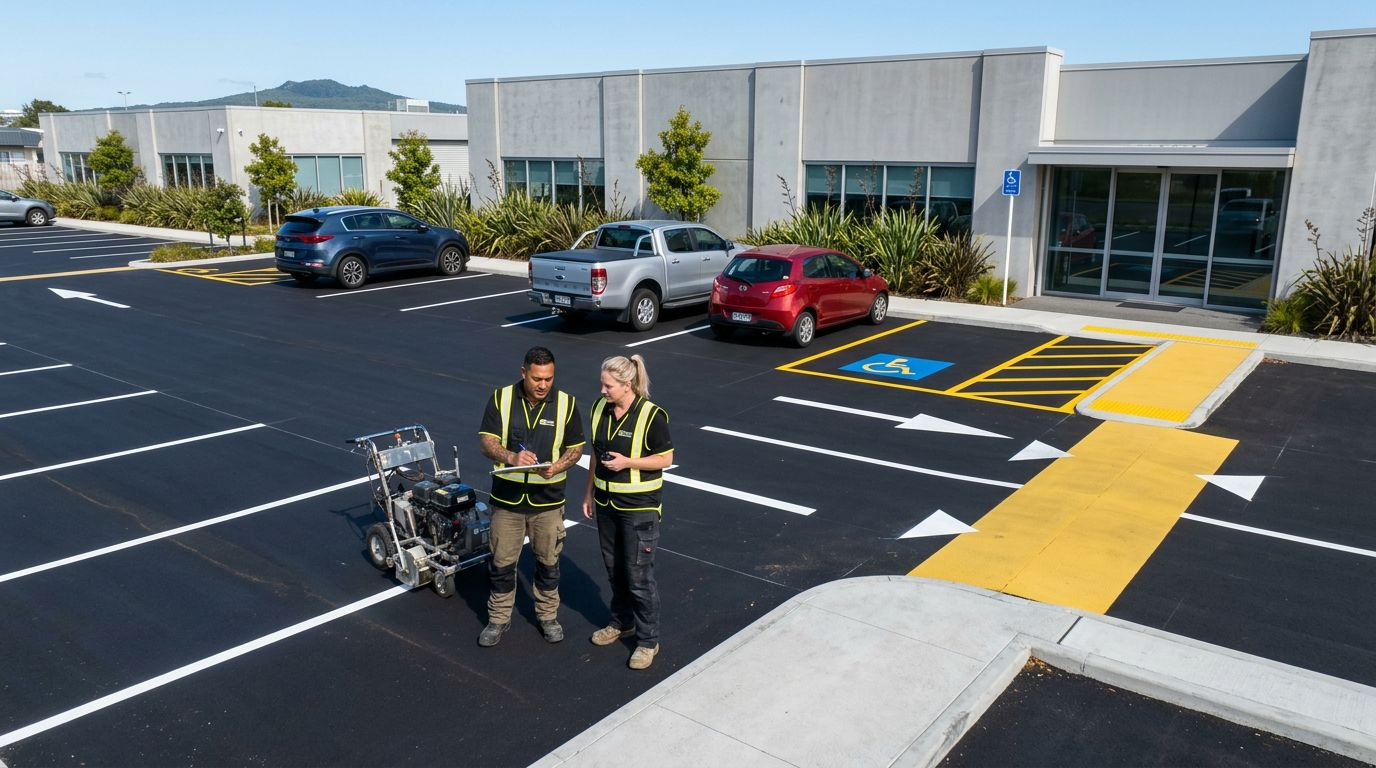
What are the required dimensions for a disabled parking bay? A standard wheelchair-accessible parking bay in New Zealand must be 3.5 metres wide to allow for safe entry and exit. This extra width is non-negotiable because it provides the necessary room for a wheelchair user to fully open their door and deploy a hoist or ramp. According to BRANZ, parking areas for wheelchair users should be 3.5 metres wide, compared with 3.0 metres for ambulant disabled people who do not require a wheelchair but still need extra space.

In our experience, trying to squeeze these bays into tight corners often leads to unusable spaces. The ground must be level, with a maximum gradient of 1 in 50 in any direction. If the surface is too steep, a wheelchair can roll away or a vehicle hoist may become unstable. We always check these measurements on-site to ensure the final markings provide a practical, usable space that meets every centimetre of the regulation.

Strategic Layout and Access Routes

The location of your disabled bays is just as important as their size. New Zealand regulations require accessible parking spaces to be designed so people with disabilities do not have to pass behind parked cars when moving to an accessible route or approaching an entrance. This is a critical safety feature that prevents drivers from reversing into pedestrians who may be in their blind spots.

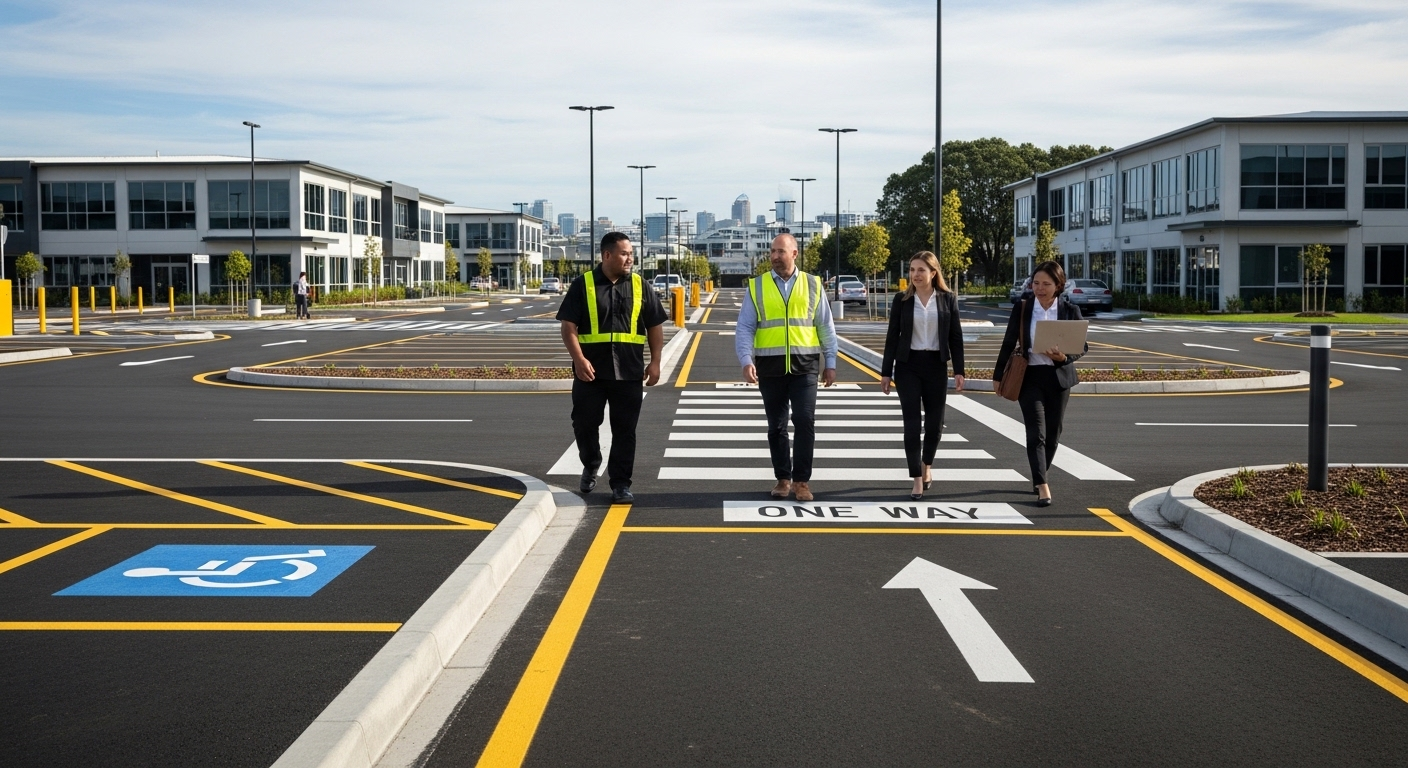
The path from the car park to the building entrance, known as the accessible route, must be clear and unoccupied. These accessible routes should have a minimum clear width of 1,200 mm. This ensures that two people can pass each other or a wheelchair user has enough room to turn. When we assist with the design and layout of compliant disabled bays, we look at the entire journey from the car to the door to ensure there are no "dead ends" or dangerous crossings.

The Role of Signage and Colour Contrast

Clear visibility is the key to maintaining the integrity of your disabled bays. If a space is not clearly marked, other drivers will inevitably use it, causing frustration and access issues. The standard requires the International Symbol of Access (the wheelchair stencil) to be clearly displayed on the ground and, in many cases, on a vertical sign. The use of high-contrast yellow or white lines against a blue background helps the bay stand out, even in low light or rain.

We use specialised, durable paints that maintain their colour and slip-resistance over time. Faded markings are a common mistake we observe, as they lead to confusion and accidental non-compliance. Keeping your stencils sharp and your colours bright is a simple way to maintain a professional and inclusive facility.

Why Use a Professional Line Marking Contractor?

Why is professional line marking necessary for compliance? Professional line marking ensures that every measurement, stencil, and colour contrast meets the exact specifications of NZS 4121:2001, protecting your organisation from legal risk. We've seen many DIY attempts where the bays are too narrow or the paint peels within months. Using a specialist ensures the job is done correctly the first time with industrial-grade materials.

At Hanover Linemarking Services, we provide professional disabled parking line marking in Auckland and across the North Island. We help you optimise your space while ensuring you stay on the right side of the law. If you are planning a full car park refresh, you can learn more about our car park line marking in Auckland to see how we integrate disabled bays into a wider traffic management plan. Costs can vary depending on the number of bays and the condition of the surface, so we provide tailored quotes based on your specific site needs.

The Future of Accessibility Standards in New Zealand

While NZS 4121:2001 remains the current legal standard, the landscape of accessibility is evolving. A government-commissioned scan, as detailed by Deaf Aotearoa, concluded that a small update to NZS 4121 will not be enough to meet current needs. The report recommends a broader revision to include more inclusive language, better emergency evacuation procedures, and considerations for sensory environments.

We stay informed about these potential changes to ensure our clients are always ahead of the curve. Adopting best practices today, such as wider access routes or better lighting, prepares your facility for future regulations. Accessibility is a continuous improvement process. By focusing on the needs of all users now, you create a car park that is truly fit for purpose for years to come.

Disclaimer: The information provided in this article is intended for general guidance on building standards and line marking compliance. For specific legal or architectural advice regarding your property, please consult with a qualified building surveyor or legal professional.

by The Hanover Linemarking Team 1 September 2026
Understand the difference between a speed hump and a speed bump for your NZ property. Learn how professional traffic calming installation improves safety and flow.
by The Hanover Linemarking Team 14 July 2026
Discover 7 common car park marking mistakes that risk safety and compliance. Learn how professional car park line marking in Auckland and Waikato improves flow.
by The Hanover Linemarking Team 29 January 2026
Discover why professional line marking is a critical safety investment for Auckland businesses. Learn how Hanover Linemarking's expert services enhance safety, efficiency, and compliance in car parks and warehouses.
by The Hanover Linemarking Team 20 November 2025
Transform your school or club's space with professional court and playground marking. Our guide covers safety standards, costs, and creative ideas for NZ conditions.
Two workers striping a parking lot with yellow paint. One on the left is on the phone. The other on the right is guiding the machine.
13 October 2025
Discover why professional line marking services in NZ, like Hanover Linemarking, offer superior quality and long-term value compared to DIY. Get expert road marking and car park solutions.

Warehouse interior: Forklifts and workers in safety vests; pallets and shelving with products.
18 August 2025
Boost safety and efficiency in your NZ warehouse with professional line marking. Our guide covers everything from durable materials to compliance standards.
Handicapped parking space with wheelchair symbol painted on gray pavement, with bumpers and yellow pole.
24 July 2025
Discover why professional car park line marking is essential for safety, compliance, and customer experience in New Zealand. Contact us for expert linemarking services.

Children playing hopscotch on a colorful asphalt playground. They run toward the viewer with joyful expressions.
7 May 2025
Need line marking in NZ? Learn how to choose the right marking solution for your car park, warehouse, or road. Hanover Linemarking: Auckland specialists.